


Table of Contents
Leather and Kydex holsters differ mainly in flexibility, body feel, retention characteristics and resistance to moisture, and neither material is universally better.
Leather gradually conforms to the firearm and body, while Kydex uses a rigid thermoformed shell that keeps a consistent shape. Both leather holsters and Kydex holsters can work for concealed or open carry when properly fitted.
For users asking whether leather or Kydex is better for a holster, leather generally favors comfort, quieter handling and body conformity, while Kydex favors rigid structure, weather resistance and easier one-handed re-holstering.
In practical terms, the best holster material depends on carry position, climate, daily wear duration and personal preference.
Leather vs Kydex Holsters at a Glance
Leather and Kydex solve the same basic carry problem through different material characteristics.
Leather is flexible and changes gradually with use, while Kydex remains rigid and maintains the shape created during thermoforming.
For users asking for a quick leather vs Kydex holster comparison, leather usually leads in body conformity and quiet handling while Kydex leads in rigidity, moisture resistance and re-holstering consistency.
In practical terms, neither material wins every category.
| Factor | Leather | Kydex |
|---|---|---|
| Comfort | Softens and conforms to the body | Rigid and can create pressure points |
| Retention | Molded friction or additional retention devices | Defined passive retention from rigid molding |
| Draw speed | Smooth after proper break-in | Consistent with minimal material movement |
| Re-holstering | Can be slower if the mouth flexes | Usually easier one-handed |
| Concealment | Conforms well to body shape | Can use a thin, rigid profile |
| Durability | Long-lasting with proper care but can soften over time | Holds shape well but can crack or deform if severely stressed |
| Maintenance | Requires occasional cleaning and conditioning | Generally requires simple cleaning |
| Weather resistance | Can absorb moisture | Highly resistant to sweat and rain |
| Break-in | Usually requires some settling or break-in | Little to no traditional break-in |
| Fit to body | Gradually adapts to the wearer | Retains its original rigid shape |
What Is a Leather Holster
A leather holster is a firearm carrier made from shaped and stitched leather that is molded around a specific handgun or handgun family.
Quality leather is formed around the firearm profile so that the finished holster provides retention through its molded shape, stitching and, where used, an additional retention device. The material can continue to settle and conform with regular use.
For users asking how a leather gun holster works, the leather holds the firearm through the shape created during molding while gradually adapting to normal body contact.
In practical terms, a leather holster combines structured firearm fit with a material that becomes more flexible over time.
What Is a Kydex Holster
A Kydex holster is a rigid holster formed from a thermoplastic sheet heated and molded around a specific firearm shape.
Once cooled, the material keeps its molded geometry rather than gradually conforming to the user's body. This allows defined retention around selected parts of the handgun.
For users asking how a Kydex holster works, its rigid shell holds the firearm through precisely formed contact points and maintains those contact points during normal use.
In practical terms, Kydex holsters prioritize structural consistency and resistance to moisture.
Leather Holster Pros and Cons
Leather holsters provide strong comfort and body conformity but require more care and can change shape with prolonged use.
Their flexible construction can make extended carry comfortable, but leather reacts more to moisture, pressure and age than a rigid thermoplastic.
For users asking are leather holsters good, they are a practical option when comfort, traditional construction and gradual body conformity matter more than maximum rigidity.
In practical terms, leather has clear advantages and clear maintenance requirements.
Advantages of Leather Holsters

Leather holsters offer comfort, quieter handling, body conformity and broad suitability across traditional carry positions.
The material softens slightly through use and can distribute contact over a larger area instead of maintaining hard edges against the body.
For users asking what the benefits of a leather pistol holster are, the main advantages are comfortable body contact, reduced handling noise, adaptability and suitability for larger traditional holster designs.
In practical terms, four common advantages are:
- Leather gradually conforms to body shape.
- Leather is generally quieter during handling and re-holstering.
- Leather can be comfortable during extended wear.
- Leather works well for IWB, OWB, shoulder and cross draw designs.
Drawbacks of Leather Holsters
Leather holsters require more maintenance and can soften, absorb moisture and lose some structure over long periods of use.
A new leather holster may also require a break-in period, and a flexible holster mouth can make one-handed re-holstering slower than with a rigid shell.
For users asking what the disadvantages of leather holsters are, the main issues are moisture absorption, gradual material change, maintenance and less rigid re-holstering.
In practical terms, four common drawbacks are:
- Leather can require a break-in period.
- Leather needs occasional cleaning and appropriate care.
- Leather can absorb sweat or rain and should be allowed to dry properly.
- Leather can soften over years of use and may become slower to re-holster one-handed.
Kydex Holster Pros and Cons
Kydex holsters provide rigid retention, weather resistance and consistent re-holstering but can feel harder against the body.
The material does not adapt significantly to body shape, so pressure points that exist when the holster is new generally remain unless the holster position or hardware is adjusted.
For users asking whether Kydex holsters are good, they are a practical option when rigidity, low maintenance and consistent firearm positioning are priorities.
In practical terms, Kydex also has meaningful strengths and compromises.
Advantages of Kydex Holsters

Kydex holsters offer rigid construction, consistent retention, strong weather resistance and straightforward one-handed re-holstering.
Because the holster mouth retains its shape when the firearm is removed, the user does not need the material to be pushed open before reinsertion.
For users asking what the benefits of a Kydex holster are, the main advantages are structural consistency, moisture resistance, predictable retention and easy re-holstering.
In practical terms, four common advantages are:
- Kydex maintains its molded shape.
- Kydex handles sweat and rain well.
- Kydex provides consistent passive retention.
- Kydex usually makes one-handed re-holstering straightforward.
Drawbacks of Kydex Holsters
Kydex holsters can feel harder against the body and do not gradually conform to the wearer's shape.
The rigid material can be noticeable during appendix or extended carry, and drawing or re-holstering often produces an audible click. Repeated contact at specific points can also make wear on a firearm's finish visible over time.
For users asking what the disadvantages of Kydex holsters are, the main compromises are body comfort, noise, fixed shape and potential finish wear at repeated contact points.
In practical terms, four common drawbacks are:
- Kydex can create harder pressure points against the body.
- Kydex does not adapt to body shape through use.
- Kydex retention often produces audible draw and re-holstering sounds.
- Repeated rigid contact can contribute to visible finish wear.
Comfort: Leather vs Kydex Holsters
Leather is generally more adaptable against the body, while Kydex provides a firmer and less flexible carry surface.
This difference becomes more noticeable during long wear or positions where the holster presses directly into the body, although overall comfort also depends on firearm size, holster shape and placement.
For users asking whether leather holsters are more comfortable than Kydex, leather often feels softer during prolonged body contact, while a well-positioned Kydex holster can still be comfortable for daily use.
In practical terms, comfort depends on both material and holster geometry rather than material alone.
Retention and Draw Speed: Leather vs Kydex Holsters
Kydex generally provides more mechanically consistent passive retention, while leather retention can change slightly as the material breaks in and ages.
A properly fitted leather holster can still retain a firearm securely, while Kydex commonly provides a defined release point as the handgun clears the molded retention area.
For users asking which material is faster to draw from, both can support an efficient draw, but Kydex tends to maintain more consistent material resistance while leather can become smoother after break-in.
In practical terms, holster retention and draw performance depend on fit, design and practice as much as material.
Durability and Maintenance of Leather and Kydex Holsters
Both leather and Kydex can provide long service lives, but they respond differently to moisture, heat and regular care.
Leather can absorb sweat or rain and should be dried naturally rather than exposed to aggressive heat, while occasional suitable leather care helps preserve the material. Kydex resists moisture and is easier to wash, but excessive heat can affect a thermoplastic shell.
For users asking which holster material lasts longer, there is no universal answer because leather can age gradually while Kydex retains shape well until damaged or excessively heated.
In practical terms, leather requires more routine care, while Kydex requires less maintenance but should still be kept clean and protected from extreme heat.
Concealment and Printing: Leather vs Kydex
Both leather and Kydex can conceal effectively when the holster position, firearm and clothing are matched correctly.
Leather can conform gradually to the body, while Kydex can use a thin rigid shell and concealment hardware to position the firearm close to the wearer. The broader selection of concealed carry holsters reflects that material is only one part of concealment.
For users asking whether leather or Kydex prints less, neither material automatically prevents printing because grip size, ride height, cant and clothing are often more influential.
n practical terms, concealment performance should be judged from the complete holster setup rather than the shell material alone.
Leather vs Kydex by Carry Position
The best holster material can change with carry position because body contact, accessibility and structural requirements differ.
IWB and appendix carry place more material directly against the body, while OWB, shoulder and cross draw configurations provide more space for larger holster structures.
For users asking whether leather or Kydex is better for every carry position, the answer is no because different positions reward different material characteristics.
In practical terms, carry position should be considered before choosing between leather and Kydex.
IWB Holsters: Leather or Kydex
Both leather and Kydex work for IWB carry, with leather emphasizing body conformity and Kydex emphasizing a rigid profile and easy re-holstering.
Kydex is commonly practical in hot or humid conditions because it does not absorb sweat, while leather can provide softer contact during extended wear.
For users asking about Kydex vs leather IWB carry, Kydex often suits users prioritizing rigidity and moisture resistance, while leather suits users prioritizing softer body contact.
In practical terms, IWB holsters should be compared by comfort, attachment and firearm fit as well as material.
OWB Holsters: Leather or Kydex
Both leather and Kydex are well suited to OWB carry because the holster has less direct pressure against the body than most IWB designs.
Leather provides a traditional contoured belt-carry structure, while Kydex provides a rigid shell that maintains consistent geometry.
For users asking whether leather or Kydex is better for OWB, either material can work effectively depending on concealment, retention and environmental requirements.
In practical terms, OWB holsters allow material preference to play a larger role because body pressure is generally reduced.
Shoulder and Cross Draw Holsters: Leather or Kydex
Leather is particularly common in shoulder and cross draw systems because flexible construction integrates naturally with larger harnesses and belt-mounted designs, although rigid materials can also be used.
A shoulder holster must balance the handgun across the upper body, while cross draw holsters must position the firearm securely at an angled belt location.
For users asking which material suits shoulder or cross draw carry, leather often provides more design flexibility while Kydex remains relevant when rigid retention is the priority.
In practical terms, the complete harness or attachment system matters more than shell material alone.
Which Holster Material Should You Choose
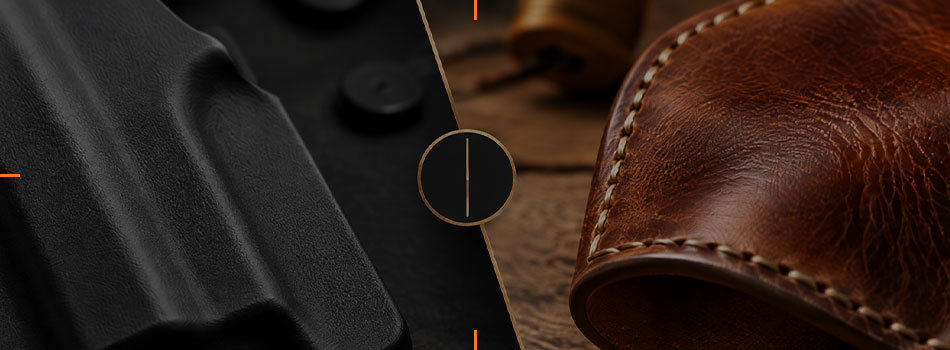
The best holster material depends on climate, carry duration, firearm size, carry position and the characteristics the individual user values most.
Kydex is often better suited to moisture-heavy conditions and rigid carry requirements, while leather can be preferable for long wear, large traditional rigs and users who value body conformity.
For users asking how to choose between leather and Kydex, the correct decision comes from matching material strengths to the intended carry environment instead of selecting one material as universally superior.
In practical terms, a properly made-to-fit holster matters more than choosing a material that is fashionable or broadly recommended.
| User profile | Better starting point | Why |
|---|---|---|
| Daily concealed carry in hot or humid climates | Kydex | Resists sweat and moisture and keeps its shape |
| Occasional everyday carry | Either | Comfort and maintenance preferences can decide |
| Range or duty-oriented use | Kydex | Rigid structure and repeatable re-holstering are useful |
| Long-barrel revolvers | Leather or purpose-built rigid holster | Carry position and firearm dimensions matter more than material |
| Appendix carry | Kydex for rigidity, leather for softer contact | User comfort and re-holstering priorities differ |
| Quiet handling is a priority | Leather | Handling generally produces less rigid-material noise |
| A holster that conforms to the body is preferred | Leather | The material gradually adapts through use |
Leather vs Kydex Holsters FAQ
Neither leather nor Kydex is universally better because each material has different strengths. Leather favors body conformity and quiet handling, while Kydex favors rigidity, weather resistance and consistent re-holstering.
Leather holsters can be very comfortable because the material gradually conforms to the firearm and body. Comfort still depends on holster design, firearm size and carry position.
Repeated contact between Kydex and a firearm can produce visible finish wear at specific contact points over time. Dirt or debris trapped inside any holster can also increase finish wear.
Both leather and Kydex can last for extended periods when properly used and maintained. Leather changes gradually with age and moisture, while Kydex holds its shape well but can be damaged by severe stress or excessive heat.
Leather holsters are suitable for everyday carry when they provide proper firearm fit, retention and trigger coverage. They require more attention to moisture and maintenance than Kydex holsters.
Many leather holsters require some break-in because newly molded leather can fit tightly around the firearm. The material gradually settles with proper use rather than maintaining exactly the same rigidity as Kydex.
Kydex can be particularly practical for IWB carry because its rigid shell resists sweat and remains open for re-holstering. Leather may be preferable for users who value softer body contact and gradual conformity.
A leather holster should be kept reasonably clean, allowed to dry naturally after moisture exposure and treated only with suitable leather-care products when needed. Excessive soaking, heat or heavy conditioning can change the leather's structure and fit.
Conclusion: Leather vs Kydex Holsters Explained
Leather and Kydex are both effective holster materials, but they prioritize different characteristics.
Leather offers body conformity, quieter handling and softer long-term contact while requiring more care and allowing gradual material change. Leather holsters therefore suit different priorities than rigid Kydex holsters.
For users asking whether leather or Kydex is the best holster material, neither is universally superior because climate, carry position, wear duration and personal preference determine which advantages matter most.
In practical terms, the better holster is the one that fits the specific firearm, carry position and user's actual daily requirements.