


Table of Contents
The Smith and Wesson Bodyguard 2.0 and Ruger LCP Max are micro-sized .380 ACP pistols developed for discreet everyday carry and personal protection. Both provide a standard 10+1 capacity, support 12-round magazines, and combine lightweight construction with dimensions suitable for pocket, ankle, or minimalist IWB carry.
The two pistols differ most noticeably in their fire-control systems. The Bodyguard 2.0 is striker-fired and uses a flat-face trigger. The LCP Max uses Ruger’s Secure Action system, which combines a protected internal hammer with a bladed-safety trigger.
The Bodyguard 2.0 is neither double-action-only nor a lightly modified version of the original Bodyguard 380. Likewise, the LCP Max should not be described simply as a traditional single-action-only pistol. Both use modern fire-control systems that differ from the mechanisms found in earlier pocket .380 pistols.
This comparison focuses on the standard Smith and Wesson Bodyguard 2.0 TS and NTS models and the standard 10-round Ruger LCP Max. Dimensions, finishes, safety features, and included accessories may differ on state-compliant, distributor-exclusive, Performance Center, and optic-equipped versions.
Smith and Wesson Bodyguard 2.0: Lightweight Striker-Fired .380 for Deep Concealment

The Smith and Wesson Bodyguard 2.0 is a striker-fired, micro-sized .380 ACP pistol designed for concealed carry and personal protection. It has a 2.75-inch barrel, an overall length of 5.5 inches, a height of 4 inches, a width of 0.88 inches, and a manufacturer-listed weight of 9.8 ounces.
The standard black model uses a stainless-steel slide and stainless-steel barrel with Smith & Wesson’s Armornite finish. Its polymer grip frame features an 18-degree grip angle, textured contact surfaces, and an undercut trigger guard intended to provide better control than the narrower grip of many traditional pocket pistols.
Unlike the original Bodyguard 380, the Bodyguard 2.0 does not use a hammer-fired double-action-only trigger. It has a striker-fired action and a flat-face trigger with an integrated trigger-safety lever. Smith & Wesson describes the trigger as having a clean take-up, crisp break, and short reset.
Smith & Wesson does not publish an official trigger-pull weight for the standard Bodyguard 2.0. Independent measurements of individual pistols commonly fall between approximately 4.5 and 5.5 pounds, depending on the firearm, gauge, and testing method. The previously reported figure of approximately 9.5 pounds applies to the older Bodyguard 380 and must not be used for the Bodyguard 2.0.
The standard Bodyguard 2.0 is supplied with one flush-fitting 10-round magazine and one extended 12-round magazine. Capacity is therefore 10+1 with the flush magazine or 12+1 with the extended magazine. The extended magazine also provides additional gripping space for shooters who cannot obtain a full grip with the flush version.
Standard models have a bright-dot front sight with a tritium insert and a black U-notch rear sight. The pistol is available as the Bodyguard 2.0 TS with bilateral external thumb-safety levers or as the Bodyguard 2.0 NTS without an external manual safety.
Ruger LCP Max: High-Capacity Micro .380 Pistol Built for Everyday Carry
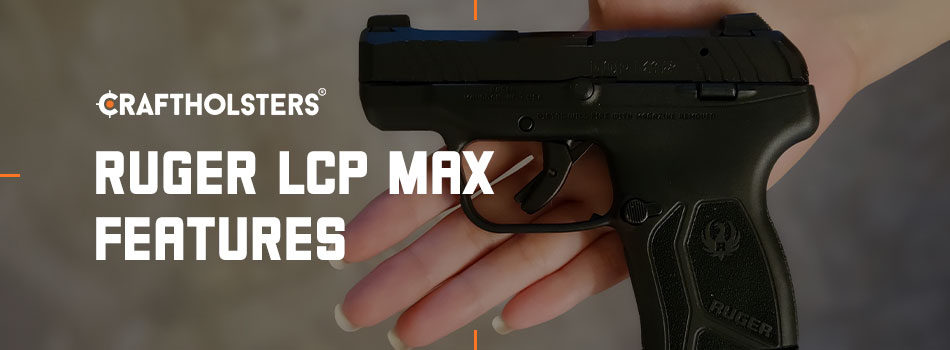
The Ruger LCP Max is a hammer-fired, micro-compact .380 ACP pistol engineered for maximum concealability without sacrificing firepower. It features a 2.8-inch barrel, overall length of 5.2 inches, and an unloaded weight of just 10.6 ounces. Despite its pocket-sized profile, the LCP Max offers an impressive 10+1 magazine capacity out of the box, with an optional 12-round extended mag available—making it one of the highest-capacity .380 pistols in the Ruger lineup.
Measuring only 0.81 inches in width and 4.05 inches in height, the LCP Max is optimized for deep concealment inside a waistband, pocket, or ankle holster. The pistol’s steel slide is treated with a black nitride finish for enhanced corrosion resistance, while the frame is made of glass-filled nylon. The standard model includes tritium front night sight with a white outline and a U-notch rear, significantly improving target visibility in low-light situations compared to the older LCP models.
The trigger system is a single-action-only, internal-hammer design that delivers a clean break at approximately 6 pounds. Recoil is sharp, as expected from a blowback-operated pistol of this size, but manageable thanks to the improved grip texture and slightly flared magwell. Despite the minimal dimensions, the pistol feels stable during rapid strings of fire, especially when using the extended pinky-rest baseplate.
Smith and Wesson Bodyguard 2.0 vs Ruger LCP Max Size Comparison
Both pistols have barrels shorter than three inches and are built around deep-concealment dimensions. The Bodyguard 2.0 has a 2.75-inch barrel, while the LCP Max has a slightly longer 2.8-inch barrel.
The LCP Max is shorter overall, measuring 5.17 inches compared with the Bodyguard 2.0’s 5.5-inch length. The Bodyguard is slightly shorter in height at 4 inches, while the LCP Max measures approximately 4.12 inches.
Smith & Wesson lists the Bodyguard 2.0 at 9.8 ounces. Ruger lists the standard LCP Max at approximately 10.6 ounces. The Bodyguard is therefore slightly lighter, although the difference is less than one ounce.
Smith & Wesson lists the Bodyguard 2.0 at 0.88 inches wide. Ruger lists a slide width of approximately 0.81 inches for many standard LCP Max configurations, although some versions have different slide dimensions. Manufacturer width figures may also be measured at different points on each firearm, so they should not be treated as a perfect comparison of overall carry thickness.
| Spec | Smith & Wesson Bodyguard 2.0 | Ruger LCP Max |
|---|---|---|
| Caliber | .380 ACP | .380 ACP |
| Action | Striker-fired | Secure Action with protected internal hammer |
| Weight | 9.8 oz | Approx. 10.6 oz |
| Height | 4.0 inches | Approx. 4.12 inches |
| Overall Length | 5.5 inches | 5.17 inches |
| Barrel Length | 2.75 inches | 2.8 inches |
| Width | 0.88 inches | Approx. 0.81-inch slide width |
| Magazine | Staggered-stack | Double-stack |
| Mag Capacity | 10+1 rounds; 12+1 with included extended magazine | 10+1 rounds; 12+1 with optional extended magazine |
| Trigger | Flat-face striker-fired trigger | Bladed-safety Secure Action trigger |
| Trigger Pull | Not officially published; independent measurements commonly range from approximately 4.5 to 5.5 lbs | Not officially published |
| Sights | Bright-dot tritium front sight, black U-notch rear | Tritium front sight with white outline, drift-adjustable U-notch rear |
| Grip Material | Polymer | High-performance glass-filled nylon |
| Manual Safety | Available with or without thumb safety | Available on selected configurations |
| Last-Round Slide Hold-Open | Yes | Yes |
| Manufacturer | Smith & Wesson | Ruger |
Smith and Wesson Bodyguard 2.0 vs Ruger LCP Max: Enhancements, Accessories & Range Performance
The Bodyguard 2.0 and LCP Max are more closely matched than their different operating systems might suggest. Both provide high-visibility front sights, U-notch rear sights, a standard 10+1 capacity, and an extended 12+1 option.
The Bodyguard 2.0’s flat-face trigger, 18-degree grip angle, undercut trigger guard, and included 12-round magazine give it handling characteristics that resemble a larger modern defensive pistol. Its grip texture covers the primary contact areas, and its slide serrations extend across broad sections of the front and rear of the slide.
The LCP Max uses raised rear cocking ears in addition to conventional slide serrations. Its optional finger-grip floorplate and extended 12-round magazine can provide additional support without changing the pistol’s basic dimensions. Its reversible magazine release also allows adaptation for right- or left-handed use.
Neither pistol has an automatic advantage in practical accuracy. Trigger preference, hand size, grip pressure, ammunition, and familiarity with the controls can affect results more than their small differences in barrel length or weight.
Because both pistols are extremely light, they generally require more deliberate grip and trigger control than a larger compact handgun. Their short sight radii and limited gripping areas can also make them less forgiving during rapid shooting or longer practice sessions.
Aftermarket support is available for both platforms. The LCP Max has been on the market longer, while support for the Bodyguard 2.0 has expanded to include model-specific holsters, replacement sights, magazines, slide assemblies, and factory optic-equipped packages.
Smith and Wesson Bodyguard 2.0 vs Ruger LCP Max: Frame, Slide, & Barrel
The standard Smith and Wesson Bodyguard 2.0 uses a polymer grip frame, a stainless-steel slide, and a stainless-steel barrel. Smith & Wesson applies its Armornite finish to the barrel and slide of the standard black models to improve resistance to corrosion and everyday wear.
The Ruger LCP Max uses a glass-filled nylon grip frame with an internal aluminum frame insert. Its barrel and standard slide are made from alloy steel, although selected versions use stainless-steel slides or alternative finishes.
The LCP Max is a recoil-operated pistol with a locked-breech, tilting-barrel action. Ruger’s barrel-cam geometry is designed to delay unlocking, reduce slide velocity, and help manage felt recoil in the pistol’s lightweight frame. It is not a simple blowback-operated pistol.
The pistols also use different slide designs. The Bodyguard 2.0 has extensive front and rear serrations that continue toward the top edges of the slide. The LCP Max combines front and rear serrations with protruding rear cocking ears.
Neither should be described as having ineffective or minimal slide-gripping surfaces. The more useful design will depend on the user’s hand strength and preferred method of retracting the slide.
In practical carry, the differences in length and weight are small. Grip shape, magazine selection, clothing, and holster design will usually have a greater effect on comfort and concealment than a fraction of an inch in either direction.
Smith and Wesson Bodyguard 2.0 vs Ruger LCP Max: Sights & Optics
Both pistols have substantially more usable sights than many earlier pocket-sized .380 pistols.
The standard Bodyguard 2.0 uses a bright-dot front sight with a tritium insert and a black U-notch rear sight. The front sight provides a visible aiming reference in daylight and reduced-light environments, while the rear U-notch leaves space around the front sight for faster alignment.
The LCP Max also has a tritium front sight with a contrasting white outline. Its rear sight is drift-adjustable and uses a generous U-notch. The squared front face of the rear sight can also provide a surface for one-handed slide manipulation.
Neither standard pistol has a conventional factory optics cut. Smith & Wesson now sells separate Bodyguard 2.0 packages fitted with a Viridian RFX1 red-dot optic, but these are different product configurations with different height and weight specifications.
The Bodyguard 2.0 does not have an integrated Crimson Trace laser. That feature belongs to selected versions of the older Bodyguard 380 and should not appear in specifications or comparisons of the standard Bodyguard 2.0.
For standard iron-sight models, neither pistol has a decisive technical advantage. Both use a tritium front reference and U-notch rear. The better system is the one the individual shooter can align most consistently.
Smith and Wesson Bodyguard 2.0 vs Ruger LCP Max: Controls
The Bodyguard 2.0 has a reversible push-button magazine release, a takedown lever, and a left-side slide-stop lever. The slide automatically locks open when an empty magazine is in the pistol.
The Bodyguard 2.0 is available in two primary safety configurations. The TS version has bilateral external thumb-safety levers, while the NTS version does not have an external manual safety. Buyers should therefore identify the exact model rather than assuming that every Bodyguard 2.0 has a thumb safety.
The LCP Max also has a reversible magazine release and an automatic last-round slide hold-open. Ruger’s manual recommends retracting and releasing the slide to chamber a cartridge after inserting a loaded magazine instead of relying on the small slide-stop lever as a prominent slide release.
Many standard LCP Max models do not have an external manual safety, but manual-safety variants are also available. Controls and safety equipment can therefore differ between model numbers.
Both pistols use compact controls to minimize bulk and reduce snagging during concealed carry. Shooters with reduced hand strength, limited dexterity, or large hands should test the magazine release, slide stop, safety, and slide manipulation before selecting either pistol.
Smith and Wesson Bodyguard 2.0 vs Ruger LCP Max: Carry & Holsters
Both pistols are suitable for discreet pocket, IWB, appendix, or ankle carry when used with a properly fitted holster.
The Bodyguard 2.0 is slightly longer but lighter. Its flush 10-round magazine provides the shortest grip profile, while the included 12-round magazine gives the shooter more gripping space and two additional rounds.
A made-to-fit Smith and Wesson Bodyguard 2.0 holster should completely cover the trigger guard, hold the firearm securely, and prevent it from rotating or shifting during movement. Pocket holsters should also keep the pistol in a consistent orientation and separate it from keys, coins, or other objects.
The LCP Max is shorter overall and follows the established pocket-carry proportions of the earlier LCP family. The standard flush magazine minimizes grip length, while the finger-grip floorplate or optional 12-round magazine can provide a more complete grip.
A fitted Ruger LCP Max holster should provide full trigger coverage, stable retention, and a consistent draw angle. Despite their similar dimensions, the LCP Max and Bodyguard 2.0 have different trigger guards, frames, slides, and controls. They should not be used in the same model-specific holster.
The firearm should also remain holstered when being placed into a pocket or bag. The carry compartment should contain no other objects that could enter the trigger guard or interfere with the draw.
Smith and Wesson Bodyguard 2.0 vs Ruger LCP Max: Why Were They Made?
Both pistols address demand for lightweight concealed-carry firearms that provide greater capacity and better sights than earlier pocket-sized .380 pistols.
The Bodyguard 2.0 represents a substantial redesign rather than a minor update of the original Bodyguard 380. Smith & Wesson replaced the older hammer-fired double-action-only system with a striker-fired mechanism, increased capacity from six rounds to 10 and 12 rounds, redesigned the grip, enlarged the usable slide-serration area, and added a tritium front sight.
The Bodyguard 2.0 therefore should not be characterized by the heavy trigger, six-round magazine, basic sights, or integrated-laser options associated with the original Bodyguard 380.
The LCP Max evolved from Ruger’s earlier LCP and LCP II designs. Ruger retained a pocket-sized profile while increasing standard capacity to 10+1, adopting a double-stack magazine, improving the sights, revising the grip, and adding prominent rear cocking ears.
Both manufacturers followed a similar overall direction: retain the concealability of a pocket .380 while improving capacity, handling, sight visibility, and practical usability.
Smith and Wesson Bodyguard 2.0 vs Ruger LCP Max: Potential Issues
The primary compromises of both pistols result from their extremely small size and low weight.
The Bodyguard 2.0’s short grip and small controls may be difficult for some users, particularly with the flush magazine. The included 12-round magazine provides more gripping space but also increases the pistol’s height. New magazines can also require significant effort to load to full capacity.
Although the Bodyguard 2.0 does not have the original model’s heavy DAO trigger, its relatively short and crisp striker-fired trigger makes complete trigger-guard coverage especially important. It should not be carried loose in a pocket, bag, or purse.
The LCP Max also has a short grip, small controls, and limited surface area for recoil management. Its rear cocking ears can make slide manipulation easier, but buyers with limited hand strength should still test the pistol personally.
Owners considering an LCP Max with a manual safety should also check Ruger’s official product safety bulletin. Ruger states that some manual-safety LCP Max pistols with serial numbers below 383100000 may have an improperly machined recess for the safety-lever detent spring. If the spring becomes dislodged, the safety lever may no longer remain in the safe position. The bulletin does not apply to standard no-manual-safety models, and Ruger provides serial-number guidance and a retrofit process for affected pistols.
Neither pistol should be assumed to function identically with every defensive load. Before carrying either firearm, the owner should test the exact magazines and ammunition intended for everyday use and follow the inspection, maintenance, and function-testing procedures in the manufacturer’s manual.
Frequently Asked Questions
No. Although both are compact .380 pistols with similar dimensions, their trigger guards, frames, slides, and control layouts are different. Each requires a holster made specifically for its own model.
No. The Bodyguard 2.0 is striker-fired and uses a flat-face trigger with an integrated trigger-safety lever. The original Bodyguard 380 used a hammer-fired double-action-only mechanism.
The standard Bodyguard 2.0 has a bright-dot front sight with a tritium insert and a black U-notch rear sight.
It is available in both configurations. The TS version has bilateral external thumb-safety levers, while the NTS version does not have an external manual safety.
Ruger does not classify it simply as a conventional single-action-only pistol. The LCP Max uses Ruger’s Secure Action system, which combines a protected internal hammer with a bladed-safety trigger and performs additional hammer cocking during the trigger pull.
Yes. Both the Bodyguard 2.0 and LCP Max have systems that hold the slide open after the last round is fired from the magazine.
Smith and Wesson Bodyguard 2.0 vs Ruger LCP Max: The Verdict
The Smith and Wesson Bodyguard 2.0 and Ruger LCP Max are closely matched micro-sized .380 pistols. Both provide a standard 10+1 capacity, tritium front sights, extended 12-round magazine options, last-round slide hold-open systems, and dimensions intended for deep concealment.
The Bodyguard 2.0 is slightly lighter and includes both a 10-round and 12-round magazine with the standard pistol. Its striker-fired action, flat-face trigger, grip geometry, and extensive slide serrations make it a strong choice for users who want a pocket-sized firearm with controls and handling characteristics similar to a larger modern defensive pistol.
The LCP Max is shorter overall and uses Ruger’s protected internal-hammer Secure Action system. Its rear cocking ears, reversible magazine release, tritium front sight, and established pocket-carry profile make it a practical choice for users who prioritize minimum overall length and a compact, proven carry format.
The Bodyguard 2.0 should not be selected or rejected based on claims that it has a 9.5-pound DAO trigger, single-stack six-round design, non-illuminated sights, integrated Crimson Trace laser, or no last-round slide lock. Those descriptions belong primarily to the earlier Bodyguard 380 or are otherwise incorrect.
The LCP Max should not be described as a blowback-operated, conventional single-action-only pistol. Ruger identifies it as a recoil-operated, locked-breech pistol using its Secure Action system with a protected internal hammer and bladed-safety trigger.
The Bodyguard 2.0 may be the better fit for shooters who prefer its grip shape, striker-fired trigger, lower listed weight, and included 12-round magazine. The LCP Max may be preferable for those who want the shorter overall pistol, Ruger’s Secure Action system, and pronounced rear cocking ears.
Neither is the automatic winner for every user. Handling both pistols and testing their triggers, sights, controls, and grip fit remains the most reliable way to choose between them.